
Food & Agriculture Asset Class
Agriculture is a real asset class worth over USD 8 trillion, offering strong returns, inflation protection and low correlation with equities and bonds.
A tangible real asset
Food and agriculture is grouped under real assets, which are physical and give investors tangible ownership. Real assets include commodities, property, infrastructure, timberland and farmland.
Agriculture's prominence has grown over the past decade, reaching over USD 8 trillion in value. That is more than all the gold ever mined and more than the global professionally managed real estate industry. Growing population demand for quality food, combined with limited and shrinking arable land, means agriculture will become even more essential.
Investors have three main routes into the sector: funds that improve and operate assets before exiting, commodity futures, or buying and managing agricultural projects directly.
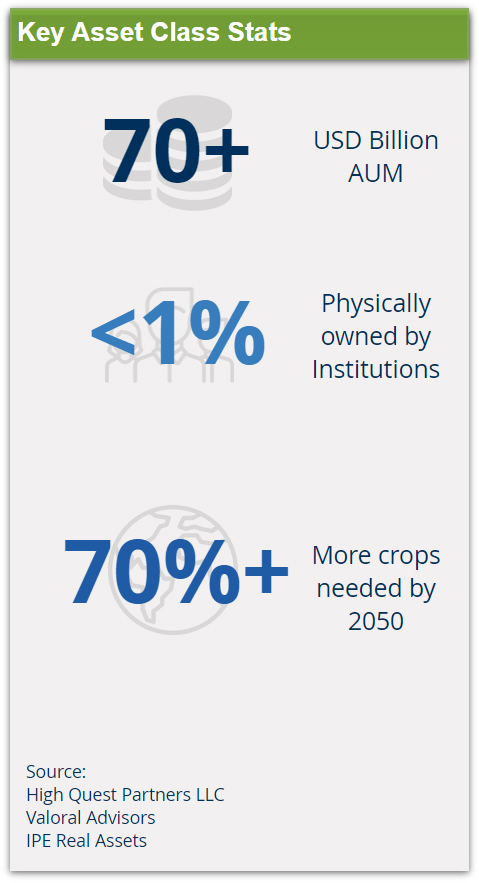
Between 2012 and 2019, investments specialising in food and agriculture grew from USD 24 billion to USD 73 billion, a 25% annual growth rate. Over 60% of this is indirect exposure via commodity futures and equities.
Nearly all physical ownership is private, and institutional investors hold only 0.50% of total value. This is slowly changing, but the sector remains fragmented, confusing and costly to enter for most investors.
Why agriculture?
The key drivers are strong supply and demand fundamentals, including population growth, changing demographics, shrinking arable land and climate change, which together create an urgent need for more productive farming.
The world will have 9.6 billion people by 2050, requiring over 70% more crops than today. With less arable land and a changing climate, Plantations International expects the sector to over-perform.
Strong returns
Agriculture has outperformed most asset classes historically, especially on a risk-adjusted basis (measured by volatility).
The NCREIF Index, regarded as the world's agriculture benchmark, has returned 13.69% a year since 2000, with a standard deviation of 7.58%. This beats equities, real estate, bonds and other asset classes, and performance is expected to improve over the next decade.

Inflation protection
Food prices track inflation, so owners of agricultural assets, and those exposed to farming businesses, have a hedge against inflation. This is a key diversification benefit.
Low correlation with other assets
Agriculture has low correlation with major asset classes such as equities and corporate debt. Adding it to a portfolio can diversify, raising returns or reducing overall risk.
Low relationship with economic cycles
Population-driven food demand is the core of agricultural commodity demand. Food demand is relatively insensitive to income, so it is less affected by economic slowdowns.
Agriculture vs. other asset classes
The chart "Annual Returns & Correlations (2001-2021)" compares agriculture with other asset classes. Source: Plantations International.
Farmers Are The Backbone of Society
Talk to our plantation team about developing, managing or owning a sustainable farm or orchard.