
Global Food Challenges
With 9.6 billion people expected by 2050 and global food demand 70% higher than today, the world faces growing pressure on land, water and food supply.
Food insecurity is an expanding global epidemic
The FAO estimates that 821 million people, about one in nine worldwide, face undernourishment and severe food insecurity.
Food insecurity contributes to both undernutrition and obesity. Limited access to healthy food pushes people towards unhealthy processed foods. Obesity is most severe in North America, but Africa and Asia, which have the lowest rates, are seeing an upward trend.
Food insecurity is driven by conflict, violence and climate variability, including more complex, frequent and intense climate extremes.
By 2050 the world population is expected to reach 9.6 billion, while the Earth's surface stays the same size. Global food demand will be 70% higher than today, which requires several key food security challenges to be addressed.
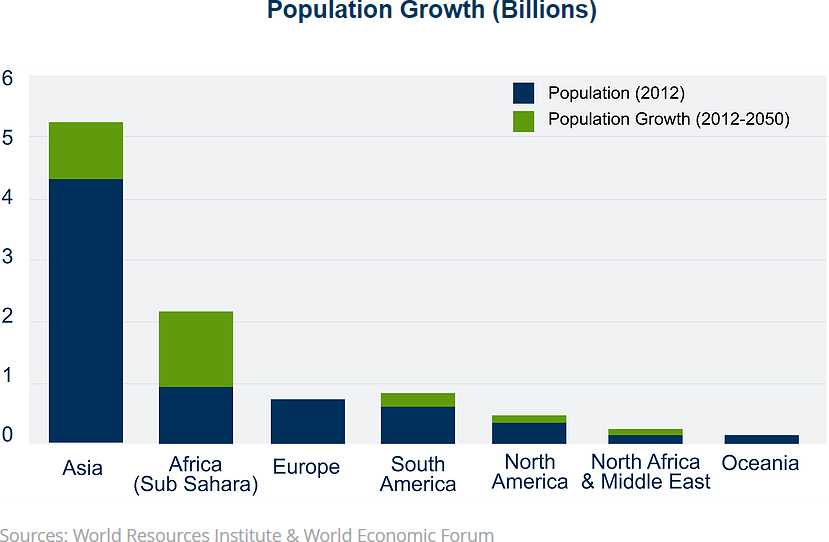
Population growth
Population growth will strain existing resources, so production must increase and become more efficient.
- About two-thirds of the world's population lives in Asia, led by India and China.
- By 2100, Africa and Asia will have 4.4 billion and 4.9 billion people respectively, together making up 83% of the world's population.
- Africa will account for over half of global population growth from now to 2050, adding 1.3 billion people.
- The United States is expected to be the fastest-growing developed country, ranking 6th in total population growth, with about 67 million more people by 2050.
Caloric requirements
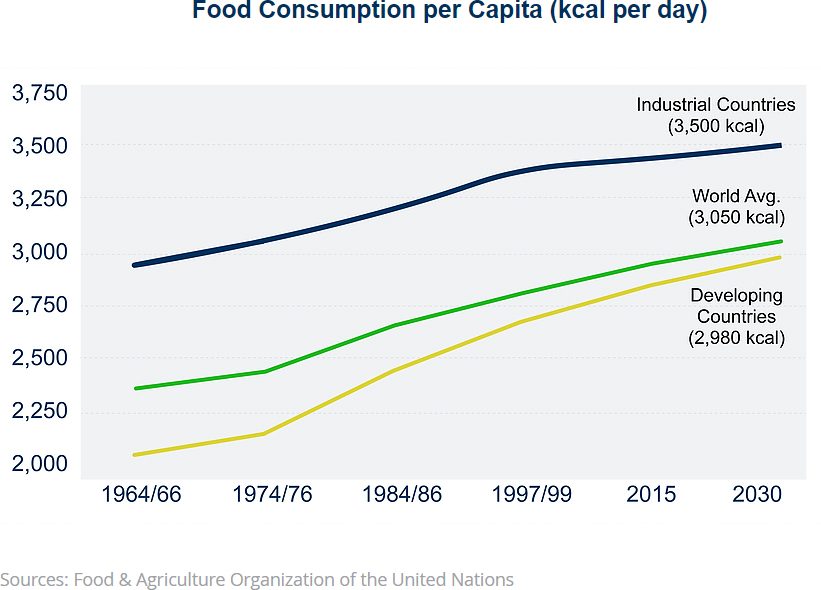
As populations grow and become more affluent, they eat more, increasing the need for food supply.
- Average food consumption has risen from 2,360 kcal per person per day in the mid-1960s to 2,900 kcal today.
- Diets have shifted towards livestock products (meat and dairy) and cereals (coarse grains, wheat and rice), and away from roots and tubers such as potatoes, sweet potatoes, yams, carrots and turnips.
- Fruit and vegetable consumption is rising as healthy eating regains popularity.
Changes in weather and arable land
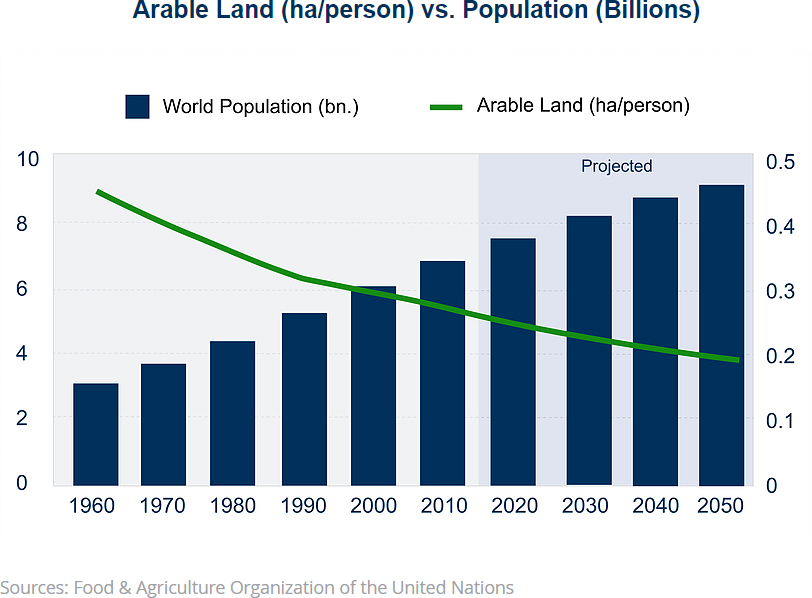
Arable land per person is shrinking as population grows, so pressure on food production and prices will keep rising. Solutions include improving productivity per acre and addressing climate change and erratic weather.
- The Earth has lost one-third of its arable land in the past 40 years.
- 40% of the world's land is arid, and rising temperatures will convert more land to desert. At current rates, today's food production will feed only half the population by 2050.
- Water scarcity is a growing crisis: 28% of agriculture is in water-stressed regions. Producing one kilogram of wheat takes about 1,500 litres of water, and one kilogram of beef about 16,000 litres. The world will need twice as much water by 2050.
Food waste
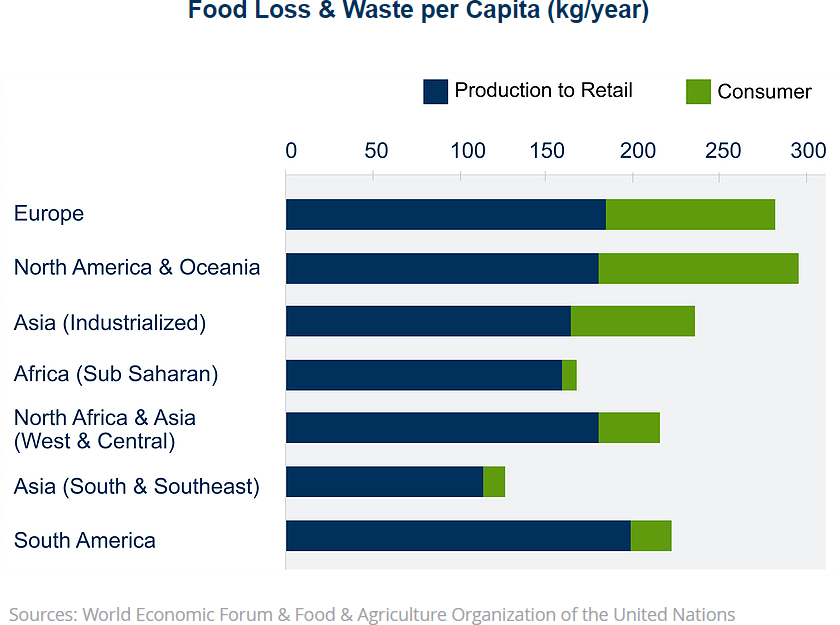
About 30% of global food production is lost after harvest or wasted in shops, households and catering services. Developing countries lose more food during agricultural production, while middle- and high-income regions waste more at the retail and consumer levels.
- The waste equals USD 750 billion per year at producer prices, or USD 3 trillion per year at retail prices.
- Food that is lost or wasted uses 1.4 billion hectares annually, equal to 28% of the world's agricultural area.
- Water used for lost or wasted food totals 250 km³ per year, three times the volume of Lake Geneva.
- The carbon footprint of food waste is estimated at 3.3 billion tonnes of CO2.
Farmers Are The Backbone of Society
Talk to our plantation team about developing, managing or owning a sustainable farm or orchard.